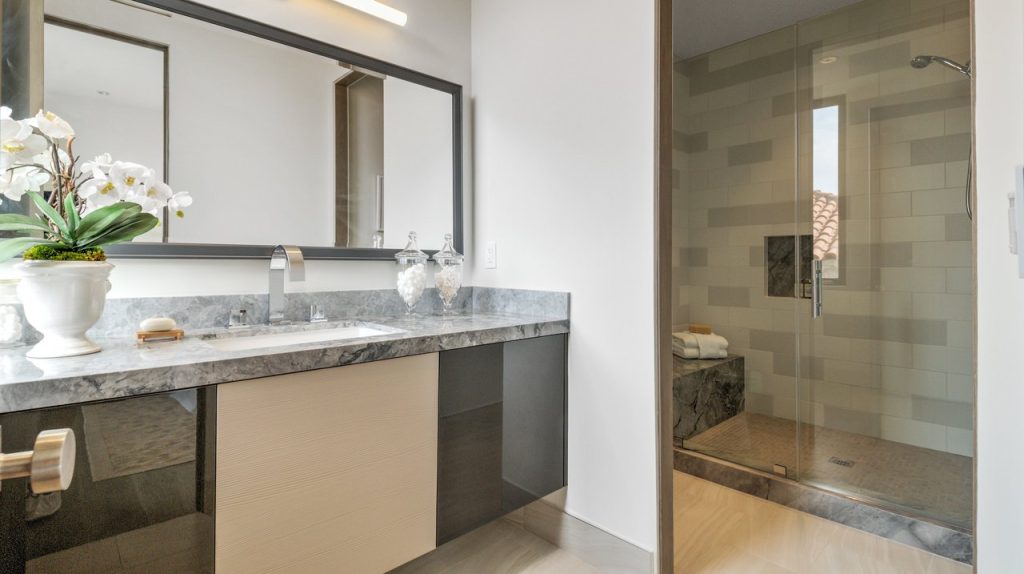
Picking a bathroom countertop is about more than color. A bathroom asks a lot of a surface, daily humidity, standing water, hot styling tools, makeup, toothpaste, & cleaning products all land on it. The right material handles that with ease for decades. The wrong one stains, etches, or wears out fast. This guide walks Atlanta homeowners through the four main stone options & how to choose the one that fits your bathroom & your routine.
Why Your Bathroom Countertop Material Matters
A bathroom is a tougher environment than most people realize. Unlike a kitchen, it sees constant moisture, frequent puddles around the sink, & regular contact with mildly acidic products like toothpaste & facial cleansers. Heat from curling irons & flat irons adds another stress. Because the space is smaller, your countertop is also front & center, you see & touch it every single day. Choosing a material that’s built for moisture & easy to maintain pays off every morning.
The Four Main Options: Granite, Quartz, Quartzite & Marble
Four stones dominate the market for bathroom vanity tops. Here’s how they compare at a glance.
| Attribute | Granite | Quartz | Quartzite | Marble |
|---|---|---|---|---|
| Type | Natural stone | Engineered | Natural stone | Natural stone |
| Durability | High | High | Very high | Medium |
| Moisture Resistance | Good (seal periodically) | Excellent (non-porous, no sealing) | Excellent (seal periodically) | Lower, porous, needs care |
| Maintenance | Periodic sealing | None | Periodic sealing | Higher care |
| Best For | Classic looks, any budget | All bathrooms, busy families | Luxury master baths | Powder rooms & statement vanities |
Granite for Bathroom Vanities
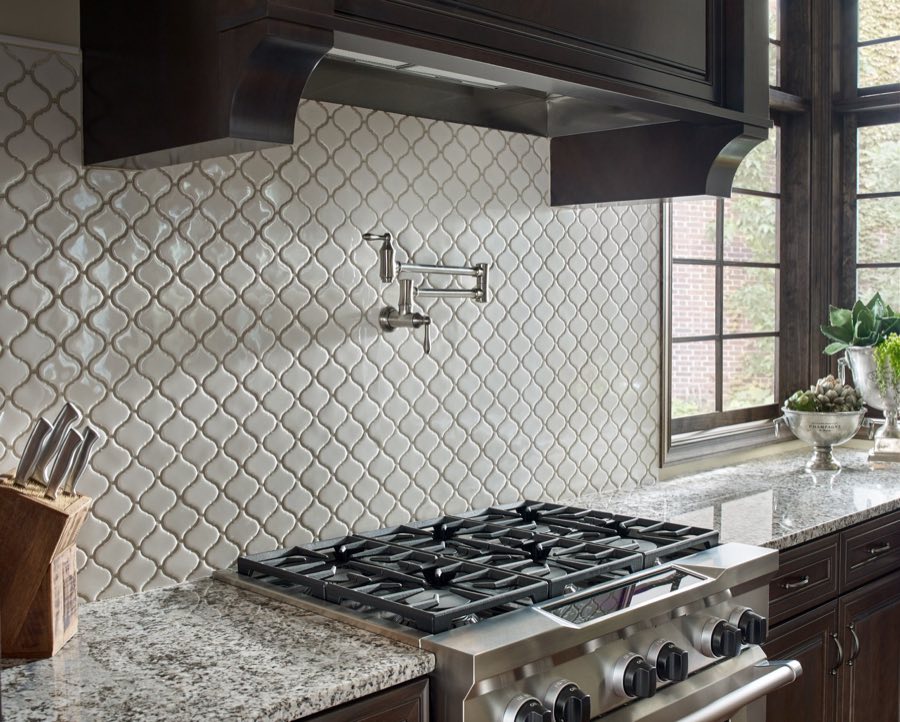
Granite is a natural igneous stone, formed as magma cooled & crystallized deep underground. It’s dense & hard, which means it shrugs off scratches from dropped grooming tools & handles the heat of a curling iron without flinching. Granite is naturally porous, so it needs a quality sealer to fully resist water & cosmetics, but once sealed, toothpaste & makeup wipe right off. A quick reseal about once a year keeps that barrier strong.
Granite’s biggest draw is variety & value. No two slabs are alike, & it offers the widest range of looks per dollar, making it a smart pick for almost any bathroom & budget.
Quartz for Bathroom Vanities
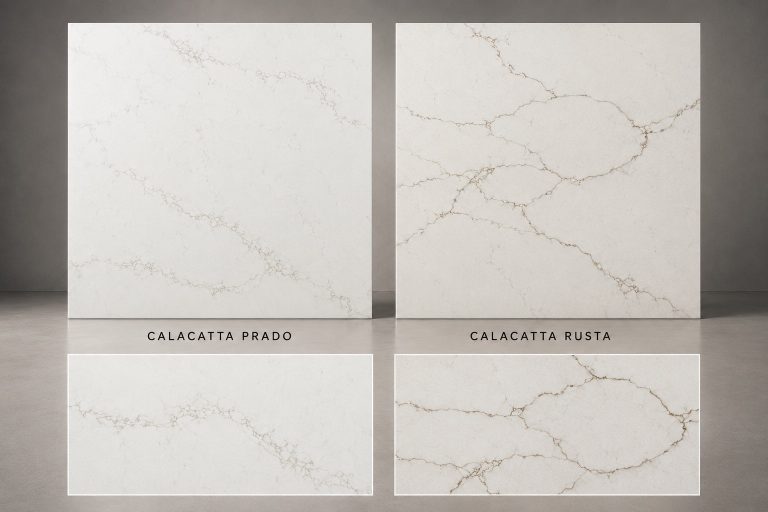
Quartz is an engineered surface, roughly 90–95% natural quartz crystal bound with resin. That manufacturing makes it completely non-porous, so it resists moisture, bacteria, & stains without any sealing, ever. For busy bathrooms & family households, that low-maintenance quality is hard to beat.
The one thing to watch is heat: the resin binders can discolor under very high temperatures, so set hot styling tools on a pad rather than directly on the surface. Quartz also comes in consistent, predictable patterns, including beautiful marble look-alikes, if you want the look of marble without the upkeep.
Quartzite for Bathroom Vanities
Quartzite is a natural metamorphic stone, formed when sandstone is transformed under intense heat & pressure. The result rivals granite in strength while showing the soft, flowing veining people love about marble. It handles heat & abrasion exceptionally well. Like granite, it’s porous & needs periodic sealing, but in return you get a genuinely luxurious natural stone that holds up to daily use, a favorite for upscale master baths.
Marble for Bathroom Vanities
Marble is the classic beauty, luminous, dramatic, & impossible to fully replicate. But it’s softer than the others & reactive to acids. Everyday items like citrus cleansers, perfume, or toothpaste can etch the surface, dulling the polish, & it scratches more easily. Over time it develops a patina that some homeowners cherish & others see as wear.
Because of that, marble shines in lower-traffic spots, a powder room, a guest bath, or a meticulous adult en-suite where it won’t take daily abuse. If you love the look but want it in a hard-working space, our Granite vs. Marble for Bathroom Vanities guide is worth a read.
What to Know About Sizing & Sink Cutouts
Bathroom vanity tops come in standard cabinet widths, commonly 30″, 36″, & 48″ for single sinks, & 60″ or 72″ for double-sink master vanities. Measure your cabinet edge to edge, & plan for a standard overhang of about an inch so water drips clear of the doors below.
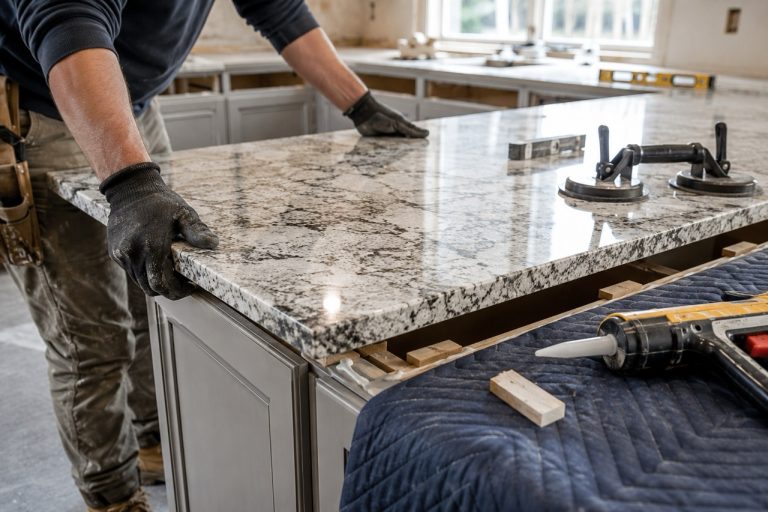
Your sink style matters too. Undermount, drop-in, & integrated sink cutouts are each fabricated differently, & the number of cutouts (plus faucet holes) factors into the work. A good fabricator templates your exact cabinet so the openings line up perfectly with your plumbing.
How to Choose a Bathroom Countertop Fabricator in Atlanta
The company you choose matters as much as the stone. The key question: do they fabricate in-house, or are they a reseller? An in-house fabricator owns its equipment, employs its own installers, & handles templating, cutting, & installation under one roof, which means no middleman markup, tighter quality control, & faster timelines. A reseller buys pre-cut stone or subcontracts the work, which adds cost & removes accountability. Always ask to visit the facility & choose from full slabs rather than small samples.
Why Atlanta Homeowners Choose Top South
For over 30 years, Top South has fabricated & installed custom stone vanity tops for homeowners across Atlanta & the metro. Everything happens at our 82,000-square-foot Marietta facility, measuring, computer-controlled cutting, finishing, & installation by our own crews. That’s the factory-direct difference: better quality, fair pricing, & one team accountable from first measurement to final install.
Come see full slabs in person at our showroom, call 770-422-4009, or request a free estimate to get started.